One robot for the whole roof.
Our robot is held by two cables and its own hose, and drives a rotating brush over the whole panel surface, row after row, on its own. You don't install a rail on every row, and nobody has to carry it from one row to the next.
- ≈500 m² per robot
- Nobody on the roof
- Reverse-osmosis water
- AI and a camera on every unit
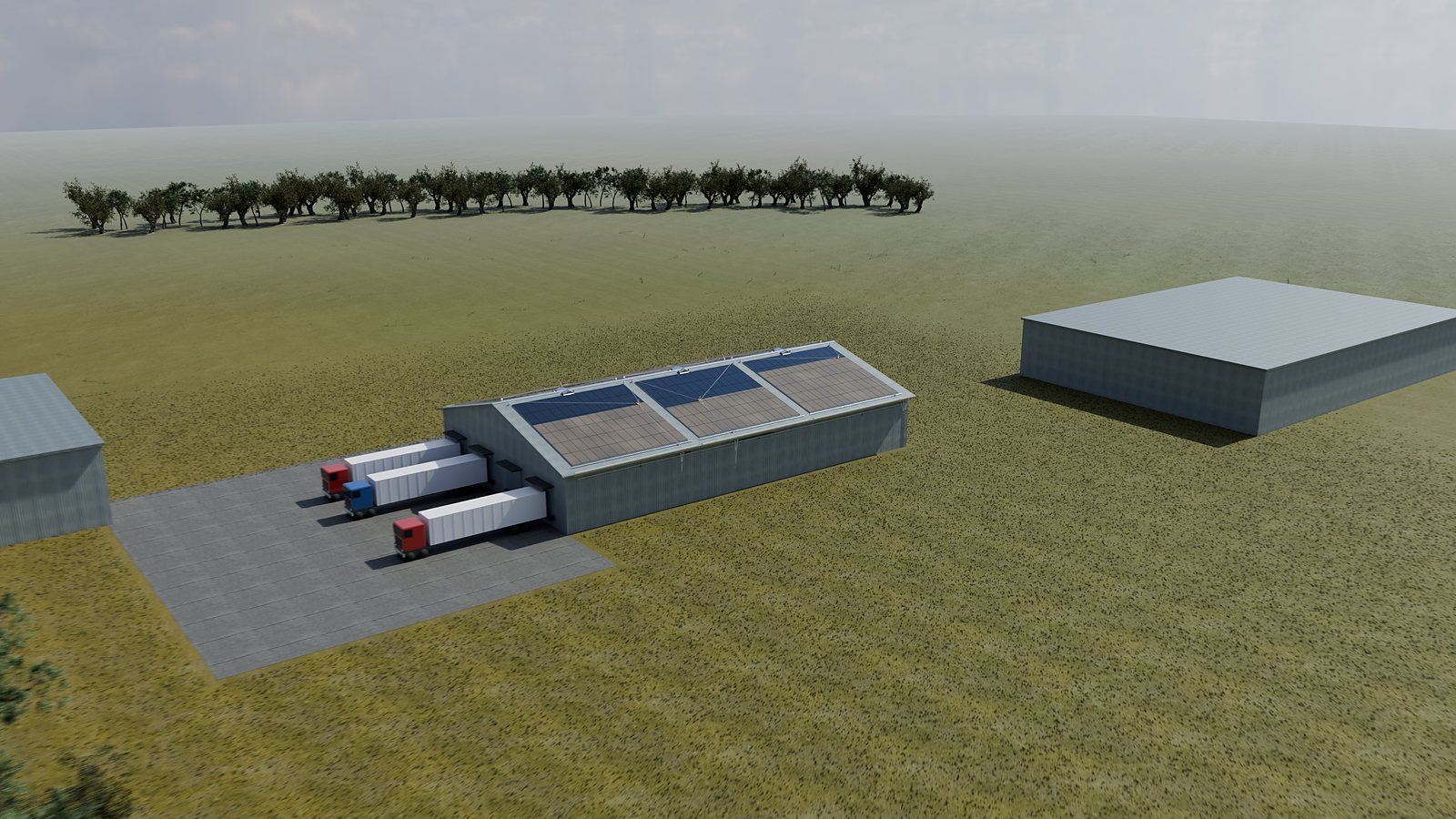
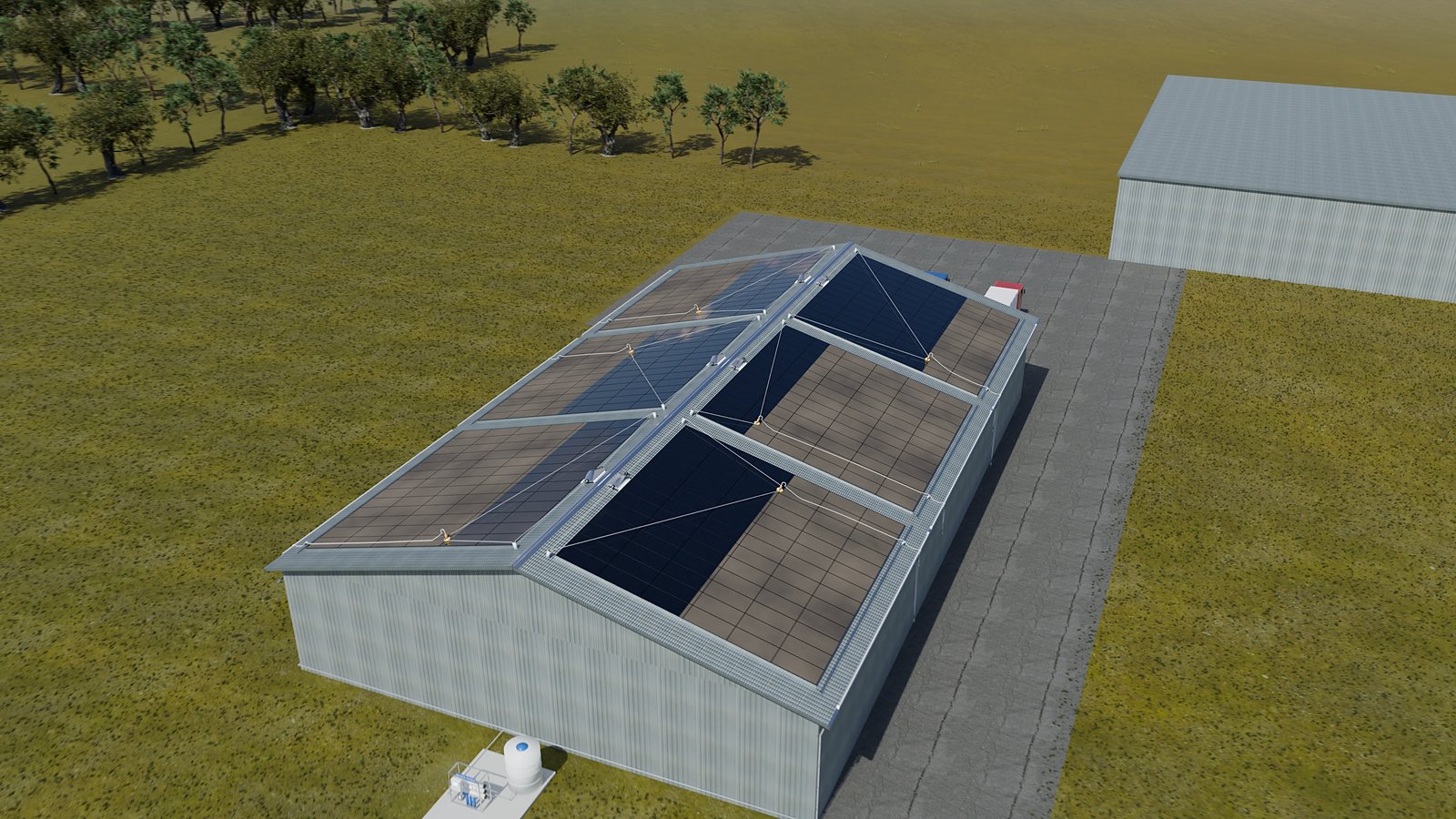
A 1,500 m² warehouse, six robots
Gable roof, 50 × 30 m: three robots on each side, each on its own field. Accelerated 3D animation based on the prototype mechanism: cables through the corner pulleys, the yellow brush, the sled on the bottom rail and the counterweighted hose.
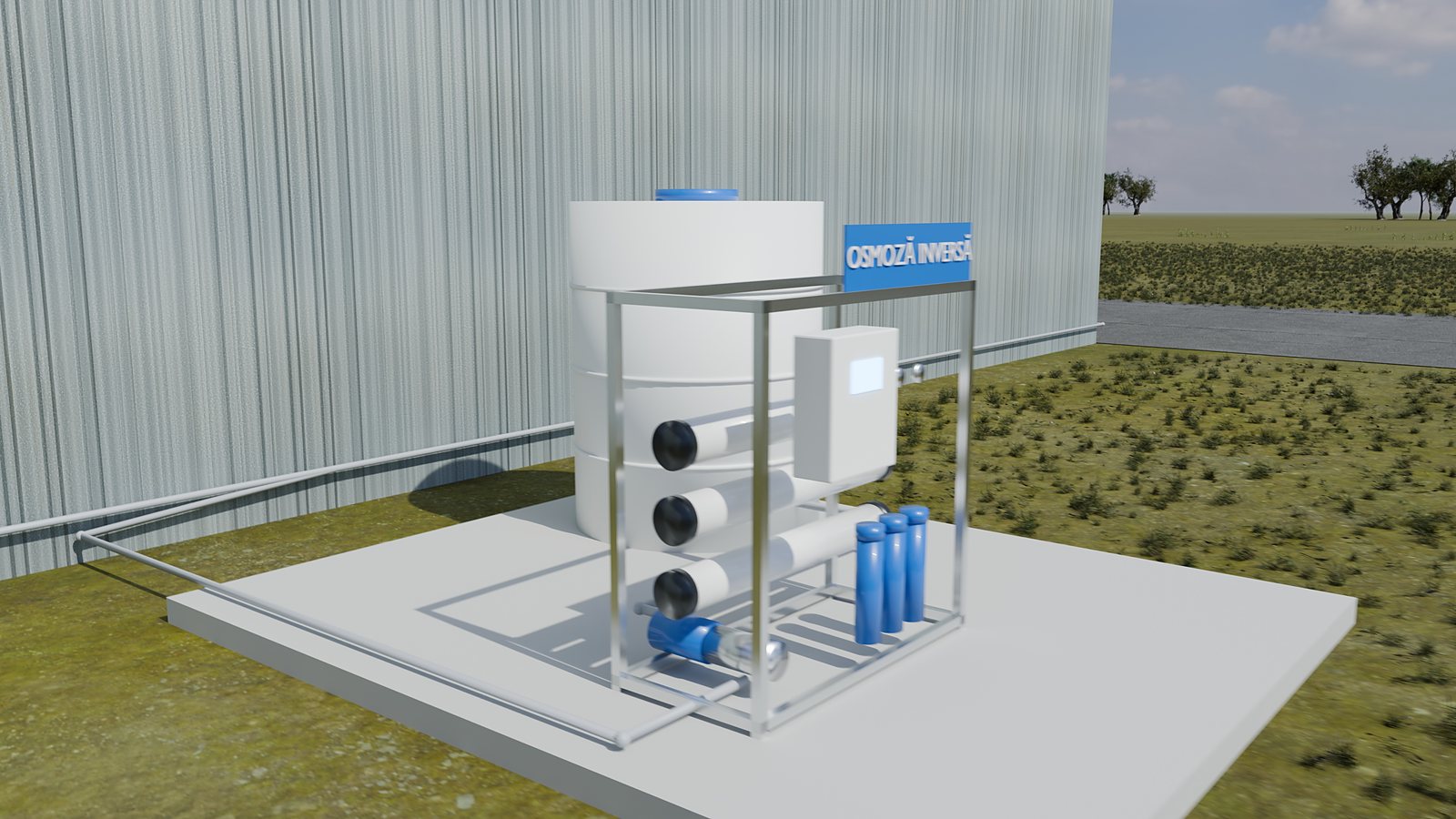
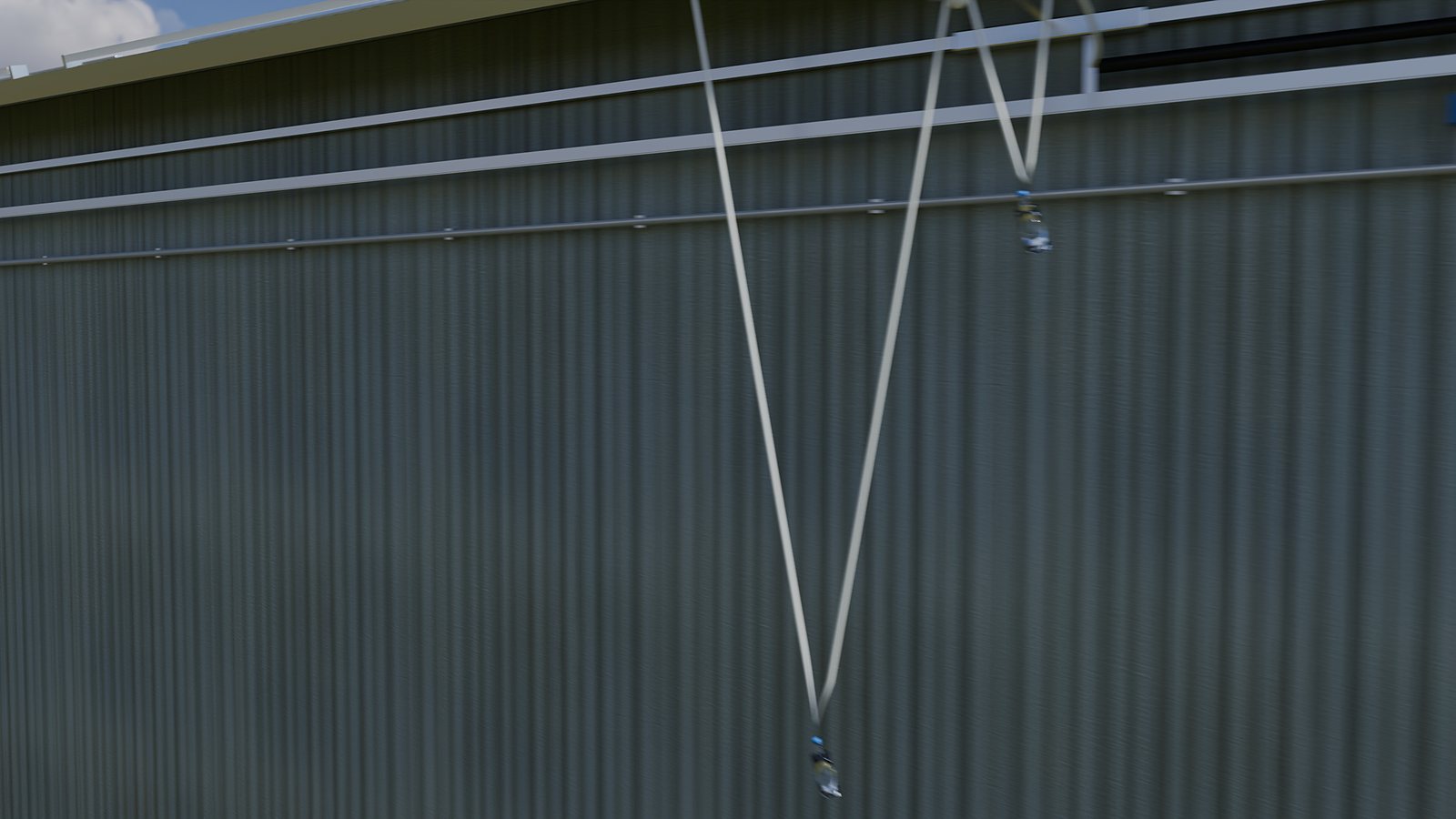
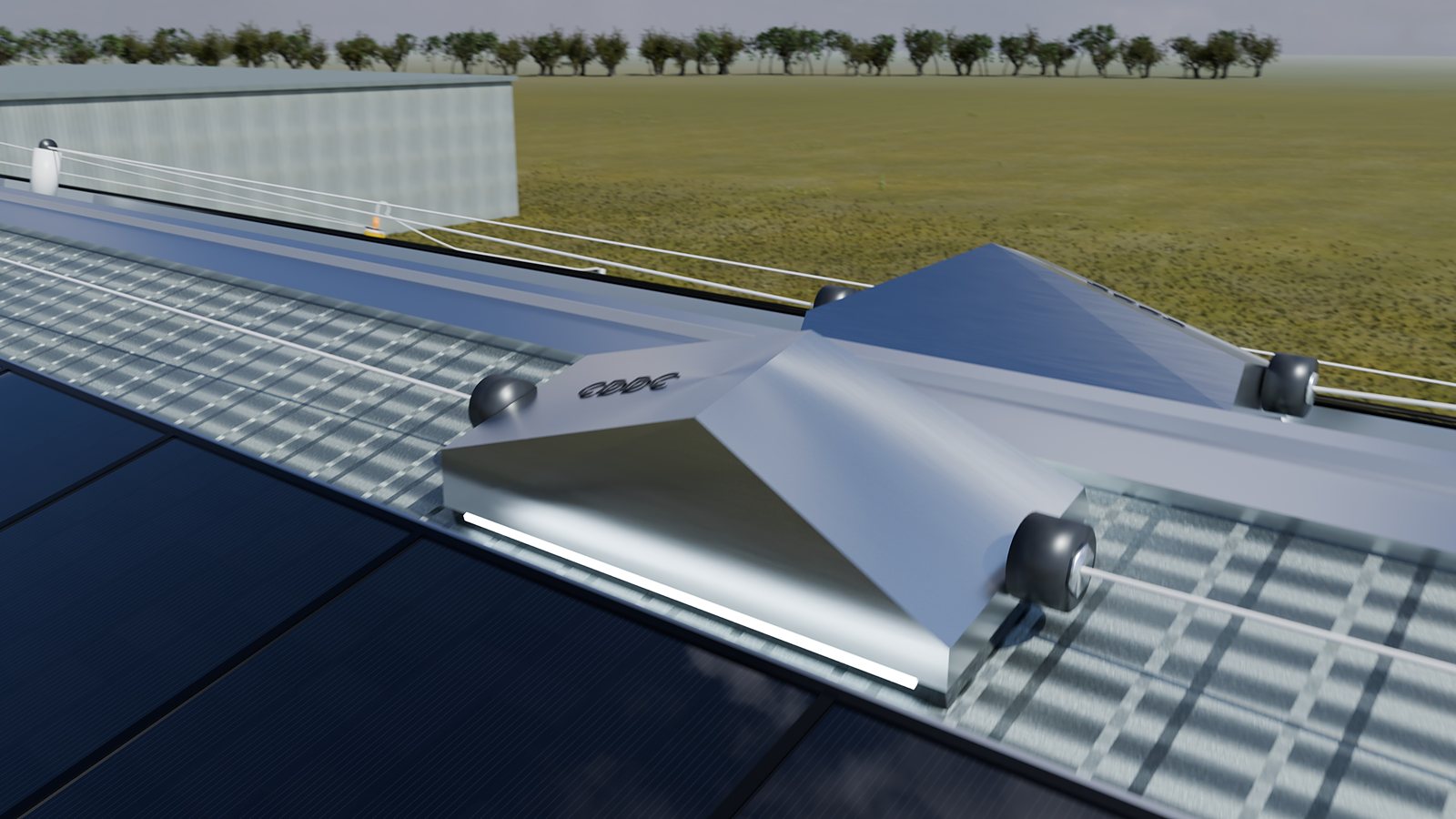
Stills from the film
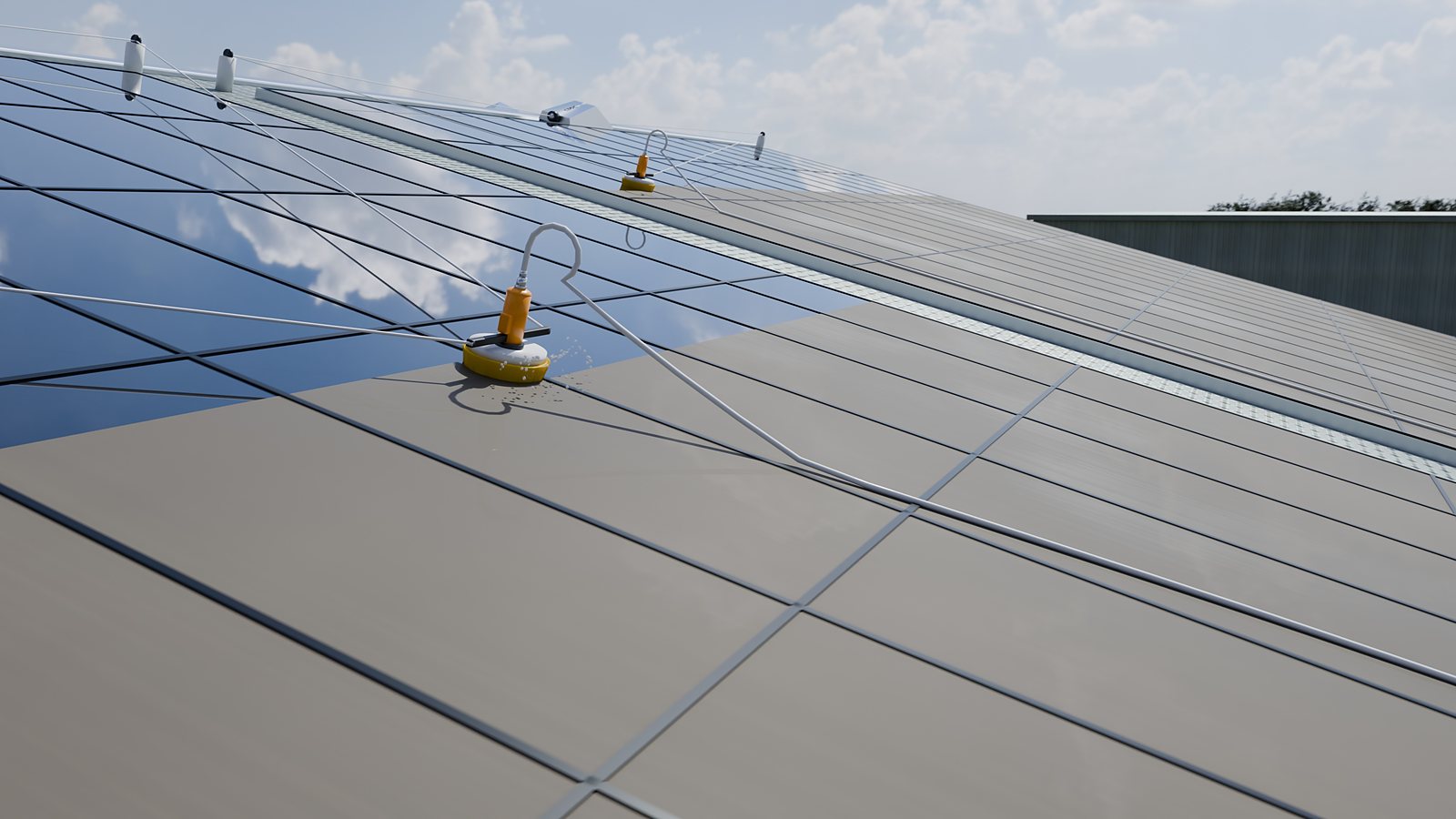
4K renders from the building animation: the osmosis unit, the hose loops with counterweights, the central unit and the brush.
Why cleaning matters
Dust, pollen, soot and bird droppings reduce panel output. On buildings near roads, farmland or industrial areas the loss builds up fast. Manual crews have to climb the roof, which is costly, hard to schedule and means working at height.
Lost energy
A layer of dirt means lost kWh on every sunny day until the cleaning crew comes back.
People on the roof
Every manual wash means work at height, safety gear, roof access and coordination with the building.
Today's robots work one row at a time
Automated products on the market either run on rails fitted to each row or are moved by an operator. On a roof with many rows, that adds up.
The numbers behind dirty panels
What a robot on the roof gets you
Manual cleaning happens a few times a year, whenever a crew and good weather line up. The robot cleans when the panels actually need it, with nobody on the roof.
More kWh, all year
Panels stay clean between washes, so you stop losing output for months while waiting for a crew.
Nobody on the roof
Cleaning no longer means work at height, scaffolding, lifts or harnesses. People go up only for maintenance.
Reverse-osmosis water, no spots
A reverse-osmosis unit on the ground makes demineralised water, as module makers recommend. No limescale marks on the glass.
Gentle on the glass
A soft rotating brush, no pressure jet, no harsh detergents. The anti-reflective coating stays intact.
Cleans at night or at dawn
The robot washes while panels are cool and idle. No thermal shock and no production lost during cleaning.
One robot, the whole field
No rails on every row and no operator to move it. We target up to about 500 m² of panels per robot.
See everything remotely
Every central unit has a camera. Watch the field live and check cleaning history and alerts from a browser or phone.
Documented maintenance
Every wash is logged with before and after photos. You have proof of proper care for the module warranty and your insurer.
How it works
We use the cable-driven parallel robot principle, the same one behind the cameras that fly over stadiums. We adapted it to clean a field of grouped panels. The robot needs a pitched roof: the counterweights pull the brush down the slope. It is not installed on flat roofs.
Motors in the middle, pulleys in the corners
The motors with their drums sit at the top, in the middle of the field. From each drum a cable runs to the pulley in the top corner and from there down to the brush.
Two cables up, the hose down
Counterweights on the hose, which lies in loops, pull the brush down and keep the cables taut. A sled on a bottom rail keeps the hose perpendicular to the brush, so the whole assembly always forms a Y. By reeling the cables in and out, the brush reaches any point of the surface.
A camera checks where the brush is
LEDs on the brush and on the hose sled blink at different rates. The camera recognises them and corrects the position so the brush stays inside the field.
Rotating brush and water
The yellow brush spins and a nozzle underneath sprays water from the hose. The robot follows a saved route over the surface, with nobody driving it, and comes with a web control panel.
Spec sheet, no hype
What the prototype does today and what we aim to prove in the pilot. Pilot figures are targets, not promises.
| Prototype today | Pilot target | |
|---|---|---|
| Area per robot | 4.4 m² (2.40 × 1.83 m) | up to about 500 m² (≈100 kWp) |
| Drive | 2 motors with drums, cables through corner pulleys | same, with long cables anchored to the existing structure |
| Cleaning head | soft rotating brush and water nozzle | same, with variable speed |
| Hose | sled on the bottom rail, loops with counterweights | same, fed from the osmosis unit through a cable chain |
| Water | pump, mains water | reverse-osmosis unit on the ground, demineralised water |
| Positioning | cable encoders, corrected by the camera tracking LEDs | plus the surveillance camera on the central unit |
| Control | web control panel, remote access | AI platform: decisions, reports, alerts |
| Roof | test field | pitched roofs, no holes in the roof covering |
Cameras and AI decide when and where to clean
Each central unit, the motor box at the top of the field, carries a surveillance camera that sees the whole surface. Its images, inverter production and the weather forecast go into the Robots & Strawberries platform, where an AI model decides which zones need cleaning and when.
Sees
The camera photographs the field at the same time and in the same light, so pictures can be compared day to day.
Understands
The AI splits the field into modules and recognises what is on each one: even dust, pollen, bird droppings, leaves or snow.
Decides
It weighs the soiling map against production loss and the forecast. Rain tomorrow? It waits. Bird droppings? It cleans just that zone. Frost? No cleaning.
Cleans and checks
The robot washes only the marked zones, at night or at dawn. The camera then takes an after photo to confirm. The report shows kWh recovered and water used.
Interface illustration with demo data. The AI decision model is in development and will be calibrated on pilot data.
Live view
See the roof any time from a phone or browser, without climbing up.
Safety stop
If a person, a large bird or a foreign object shows up on the field, the robot stops and you get an alert.
History and anomalies
We keep the photo history and a time-lapse of the field. Broken glass, fallen objects and snow are flagged right away.
A night with the robot
How the camera, the AI and the robot work together from sunset to morning. Illustrative scenario.
Last light
The camera on the central unit photographs the field, in the same light as every evening.
Analysis
The AI compares the picture with yesterday's, with inverter output and with the forecast.
Decision
Dust on field A2 and bird droppings on 3 modules. No rain for 48 hours. Cleaning set for 05:30, droppings first.
Getting ready
The osmosis unit fills the tank. The robot checks wind, temperature and that nobody is on the roof.
Cleaning
The brush leaves its parking spot, cleans only the marked zones and returns to its parking spot.
Check
The camera takes the after photo. Cleaned zones are confirmed or rescheduled.
Report
Your phone shows kWh recovered, water used and before and after photos.
What else is out there, and where we fit
We researched commercial automated cleaning solutions. They fall into three families, and none of them uses a cable-suspended robot that covers several rows at once.
| Solution type | Examples | How it changes rows | Best suited for |
|---|---|---|---|
| Rail robot, one per row | Ecoppia, Taypro, Chinese manufacturers | It doesn't. You need a robot on every row or a rail transfer system. | Large, uniform plants in arid regions |
| Operator-moved robot | SolarCleano, hyCLEANER, Sunlink | A person lifts it or drives it over on a transporter. | Cleaning contractors, ground-mounted plants |
| Arm / gantry machines | Tractor- or truck-mounted units | The vehicle drives along the rows. | Ground plants with vehicle access |
| Cable robot (us) | Robots & Strawberries | It doesn't need to. The cables carry the brush over the whole field between the pulleys, targeting up to about 500 m² per robot. | Pitched roofs with grouped panels where nothing can drive |
We also found university prototypes and patents with related principles, but no commercial product built on this approach. Company names belong to their owners and are shown for context only.
Work out what you lose and what you get back
Enter your installation's data. The starting values are typical assumptions for a commercial roof in Central Europe. Replace them with your own.
How we calculate: dirt builds up between washes, so the more often you clean, the lower the average loss. With n washes a year, we take the average loss as the yearly loss without cleaning divided by n + 1. With the robot cleaning on demand, we assume 15% of the uncleaned loss remains. CO₂ uses 0.26 kg per kWh. These are indicative estimates, not a quote. We measure the real figures together in the pilot.
Where we really are
We are a small team. The robot works on a test field, not yet on a building roof. That is exactly why we are looking for pilot partners.
Already working
- Cable prototype with a 2.40 × 1.83 m working area (about 4.4 m²)
- Fully automatic wash from start to finish, achieved in 2026
- Positioning from cable encoders, corrected by a camera tracking the LEDs
- Water pump and a separate hose sled
- Web control panel with remote access
- Surveillance camera on every central unit, with live view
Working on now
- Scaling toward our target of about 500 m² per robot (roughly 100 kWp): long cables, cable sag, wind, anchoring
- Measuring speed (m²/hour) and water use on a real surface
- Cable shadow on the panels while running
- Mounting without drilling the roof, anchored to existing structure
- AI platform that decides from images, production and forecast which zones to clean and when
Frequently asked questions
What roofs can it go on?
Pitched roofs with the panels grouped in one field: metal sheet, sandwich panel or tiles. It cannot go on flat roofs, because the brush is pulled down the slope by the counterweights on the hose.
How much area does one robot cover?
Our target is about 500 m² of panels per robot, roughly 100 kWp. On a large building you put one robot on each panel field, all run from the same platform.
Where does the water come from?
From a reverse-osmosis unit on the ground next to the building, connected to the water mains. The demineralised water goes up a pipe on the wall, then through a cable chain and a hose to the brush. The hose rises in a loop above the head and enters through a rotary union at the centre of the brush, right above the nozzle, so it never twists while the brush spins. It leaves no limescale. We measure water use per square metre during the pilot.
Will it void my panel warranty?
The robot follows module makers' general guidance: soft brush, no high pressure, low-mineral water, cleaning while modules are cool. Before installing, we check the maintenance manual of your modules.
What about winter?
It does not clean in frost. The camera shows snow and ice, and the platform resumes cleaning once they melt.
Does it shade the panels?
When idle, the brush is parked at the top edge of the field. The cables are thin, and cleaning happens at night or at dawn when panels are not producing. We measure the exact shading effect of the cables in the pilot.
What happens in strong wind?
The platform checks the forecast and does not start cleaning in strong wind. We validate exact thresholds and anchoring on a real roof in the pilot.
How can I buy it?
Two options. The Standard package is €4,900 + VAT at pre-order (list price €5,900) or, as a subscription, from €119/month + VAT on a 5-year contract, with service and platform included. For large buildings we make a custom quote after a site visit.
Pre-order
Two packages: Standard, for one panel field, and Custom, for large buildings or special roofs. Reserving is free and commits you to nothing.
Standard
One robot for a panel field of up to about 500 m² (≈100 kWp), on a pitched roof.
- The complete robot: central unit with motors and drums, cables, corner pulleys, rotating brush with a water nozzle in the centre
- Camera on the central unit
- Anchored to the existing structure, no holes in the roof covering
- Hose with a sled on the bottom rail and loops with counterweights
- AI platform: decides when and where to clean, reports and alerts on your phone
- Installation, commissioning and training
or a subscription from €119/month + VAT, 5-year contract, service and platform included
30% deposit by pro-forma invoice, after we confirm the roof.
Custom
For large buildings, several panel fields or roofs that need a tailored solution.
- Several robots, one per field. Example: a 1,500 m² building with 6 robots
- Reverse-osmosis unit on the ground, sized for the whole building
- Cleaning schedule and reports for the whole installation, on the same platform
- Connection to inverter data, so you see the energy recovered
- On-site assessment: anchoring, pitch, water access
Quote after the site visit.
Request a custom quoteHow the pre-order works
Reserve
Fill in the form and choose purchase or subscription. Free, no obligation.
We confirm
We check the roof from photos or on site and send you the delivery schedule.
Deposit or contract
You receive the pro-forma for the 30% deposit or the subscription contract. Your pre-order price stays locked.
Installation
We build the robot, install it and commission it. Slots are allocated in order of reservation.
The pilot program
We are looking for a small number of commercial or industrial buildings with rooftop solar, where we install the robot on a section and measure the results together. Our target is for one robot to cover up to about 500 m² of panels (roughly 100 kWp). Larger roofs get several robots, each on its own field. Example: a warehouse with about 1,500 m² of gable roof gets three robots on each side.
Tell us about the roof
Fill in the form below. We call you and ask for a few photos and the installation details.
Site visit
We come on site, check anchoring and water access, and pick the test section.
Install and measure
We mount the robot and compare the output of the cleaned section against an uncleaned one. Pilot terms are agreed after the visit.